

Game Rules
Rules for the three game variants of Cyber Defence Dice.
Video animated by Victoria Todd
General Rules
Each side (individual players or teams) gets a set of five dice – the red set for Attackers, the blue set for Defenders.
Each round can have up to three throws per side, but the side throwing first can choose to stop after one or two throws if preferred. The side throwing second is limited by the number of throws taken by the first side.
At the end of a round, sides win, lose or draw based on the dice thrown.
Game Variants
There are three suggested games, each with different ways of using the dice and increasing complexity to play.
The aim is to match against an attack or defence thrown by the opening side, by responding with a compatible defence or attack.
To Play
Either side may start the game, and play is then determined by the winner of prior rounds.
Players choose which dice to keep or throw again, and may change their mind on which to keep from one throw to the next.
After their chosen number of throws (to a maximum of 3), the opening side declares what their resulting attack or defence is.
All dice in a declared attack or defence must be of the same type (e.g. an attack cannot be a mix of Malware and Hackers – one or the other must be declared).
Winning
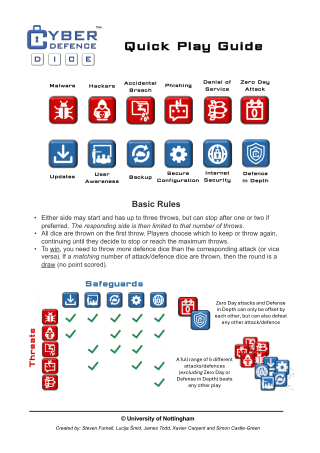
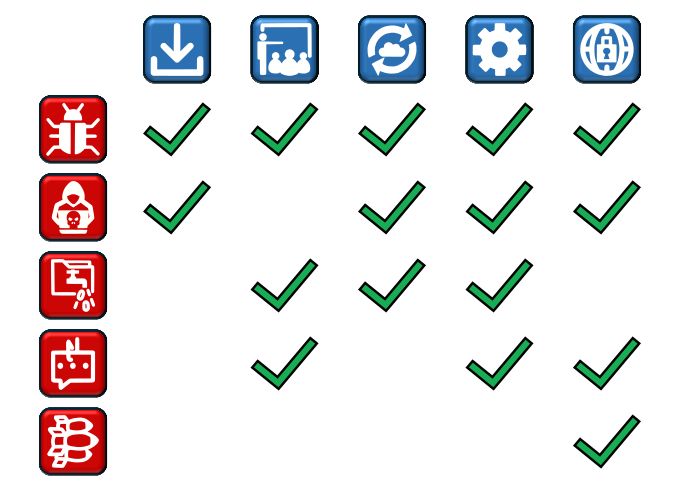
To win a round players need to throw more defence dice than the corresponding attack (or vice versa) – e.g. if 2 Malware dice are thrown then defenders need 3+ of other relevant dice to defend (e.g. 3 Backup, 3 Configuration or 3 Internet Security).
If a matching number of attack/defence dice are thrown (e.g. 3 Malware and 3 Backup), then the round is a draw (no point scored).
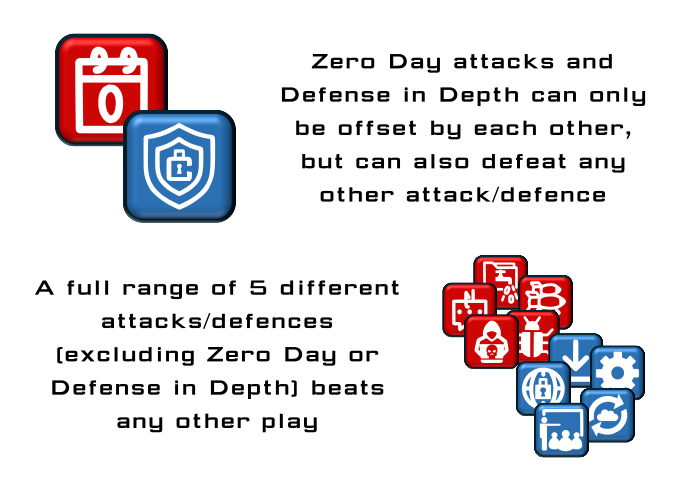
Combined Attacks or Defences can be used to defeat any type of declared attack/defence:
- a Combined Attack is a set of Malware, Hackers, Accidental Breach, Phishing, and Denial of Service.
- a Combined Defence is a set of Updates, User Awareness, Backup, Secure Configuration, and Internet Security.
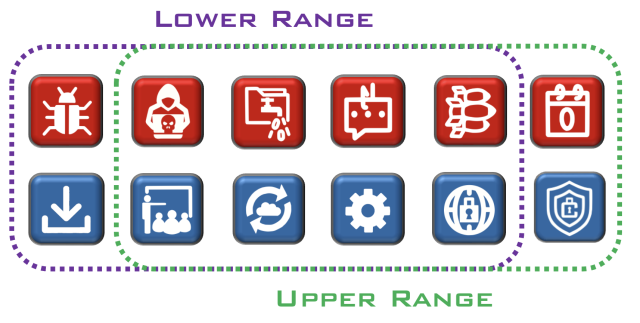
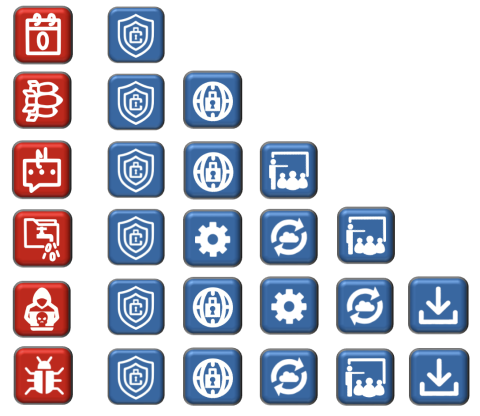
Gameplay with Assets (Deluxe version only)
At the start of the game, Assets can be distributed in different ways:
- Split equally, such that side starts with three Assets. Play continues until one side has acquired all six.
- Play starts with all six Assets in the middle. Play continues until one side has acquired all six.
- Play starts with all six Assets held by the Defender. The Attacker has N rounds in which to acquire all six (where the players agree N, but 15 is a suggested value). Note that in this version of the game, the Attacker always starts and chooses the Asset they wish to target.
Each round begins by nominating an Asset to play for. This can be done by:
- direct choice (if Assets are face up)
- blind choice (with Assets face down)
- rolling the Assets die.
The starting side attempts to throw an Attack or Defence appropriate to that Asset (see Assets matrix below).
If a valid combination is thrown, the responding side uses the standard Match Mode attack/defence matrix. If a valid combination is not thrown, play switches to the other side.
To win the Asset the responding side needs to beat the opening side’s throw.
If the opening side wins the Asset, they continue to lead the next round. If not, the Asset stays where it is and play switches to the other side to start the next round.